




Can you imagine seeing a whale up close and interacting with it? This is one of the most emotional and exciting experiences in the world, and you don’t have to travel far to meet these nomads of the sea. In the Municipality of La Paz, you can experience the annual migration of the gray whale (Eschrichtius robustus) in Puerto Chale, a small fishing village located on the Pacific coast where hundreds of gray whales arrive every winter. This place is considered one of the best sites for whale watching.
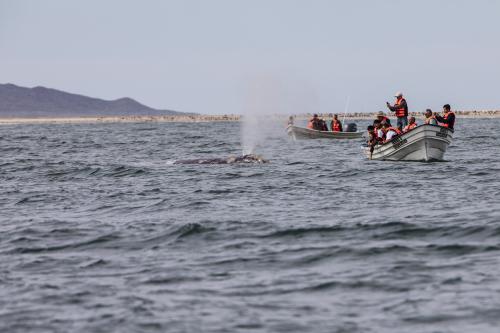
To take the day tour, we depart very early from the city of La Paz, between 7 and 8 in the morning, heading north along the Transpeninsular Highway until reaching the community of Santa Rita at kilometer 157. From there, we take a left turn and drive another 20 kilometers until arriving at the pier, where we board the boat. The local fishing cooperative is responsible for organizing the tours. You can choose between a shared or private trip, with a minimum duration of two hours, and longer tours are also available if desired.
We begin navigating through the mangroves, where we have the opportunity to observe various bird species, as well as a group of dolphins that accompany us to Bahía Almejas, a small bay located south-southeast of Bahía Magdalena. The scenery is spectacular as we head toward Isla Creciente and Isla Margarita, where a natural inlet forms and whales enter with their calves in search of refuge.
The life of the great gray whale unfolds while traveling through the waters of the Pacific Ocean, fulfilling its ancestral natural cycle. During summer, it feeds in the icy Arctic waters of the Bering, Chukchi, and Beaufort seas in Alaska. As autumn approaches, they begin their long journey of up to 18,000 kilometers in search of warmer waters. During winter, in late December and early January, they arrive at the breeding and calving lagoons located in Baja California Sur, Mexico, where the waters are warm, shallow, and calm—ideal conditions for reproduction and birth. Females give birth only once every two years, usually to a single calf, after a gestation period of 12 to 13 months. During their stay in Mexican waters, mothers nurse their calves and spend time together until April, before migrating back north to the coasts of Alaska.

Suddenly, we begin to see mothers lifting their heads, curious about our presence. Gray whales usually swim in groups of one to three individuals, although groups of up to 18 whales can also be observed. They typically remain submerged for three to five minutes; before diving, their large tail fluke can be seen, then they surface and breathe five to six times.

Slowly, we approach the group until we are completely surrounded by these marine giants. The average size of a gray whale ranges from approximately 9 to 15 meters (30–50 feet) in length and they can weigh up to 32,000 kilograms (35 tons).

Their powerful blows alerted us to their presence—they were everywhere. There were so many that we had to choose which one to photograph. A characteristic behavior of this species includes breaching, as well as resting on one side of their body while waving a pectoral fin in the air.
Finally, a mother and her calf approached our boat, curious about our presence. Making eye contact with these enormous mammals was an unforgettable experience, and the emotion is indescribable—especially when you know that 90% of the gray whales of this species are born and reproduce in sanctuaries within Mexican waters.

Mexico is a pioneer in the protection of the gray whale and continues working to ensure that all whale species are well protected in Mexican seas. If you visit La Paz in winter, don’t miss the opportunity to encounter the gray whale—it is undoubtedly one of the most rewarding and moving experiences nature has to offer.
